Cómo conectar de forma segura varios generadores de aerosol DSPA a un único panel
Conectar múltiples generadores de aerosol desde un solo panel es sencillo en teoría, pero los métodos de cableado tradicionales pueden plantear verdaderos desafíos. El cableado en serie conlleva el riesgo de fallos en un solo punto, mientras que el cableado en paralelo puede sobrecargar la capacidad del circuito de su panel. Ambos pueden comprometer la fiabilidad y el cumplimiento normativo del sistema.
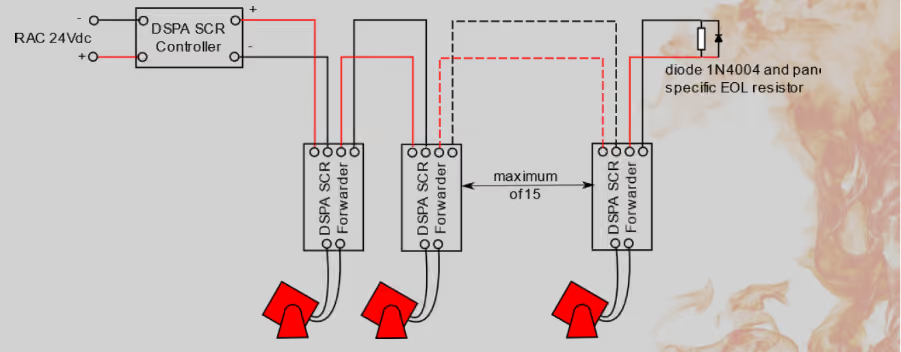
Por eso DSPA desarrolló la interfaz SCR, una solución que le permite conectar y activar de forma segura hasta 15 generadores de aerosol DSPA desde una única salida del panel, sin sobrecargar su FACP ni introducir vulnerabilidades en el cableado.
Los sistemas de extinción de incendios por aerosol ofrecen una solución modular y escalable para la protección contra incendios. Cada generador contiene un agente sólido que, al activarse, produce una nube finamente dividida de partículas extintoras. La eficacia del sistema depende de alcanzar una densidad específica de este aerosol, lo que significa que todos los generadores dentro de un área protegida deben activarse.
Una ventaja clave de los sistemas DSPA es su capacidad para interconectar generadores, lo que permite una mayor cobertura volumétrica. Estos generadores, equipados con un iniciador eléctrico, se conectan directamente a un Panel de Control de Alarma de Incendios (FACP). El iniciador contiene una resistencia que, al recibir una corriente eléctrica, se calienta e inicia una reacción química autosostenida dentro del recipiente metálico del generador. Este proceso genera el aerosol extintor.
El desafío eléctrico: conexiones en serie frente a conexiones en paralelo
Cuando se requieren varios generadores en el mismo volumen protegido, se utilizan habitualmente dos métodos de cableado: en serie y en paralelo.
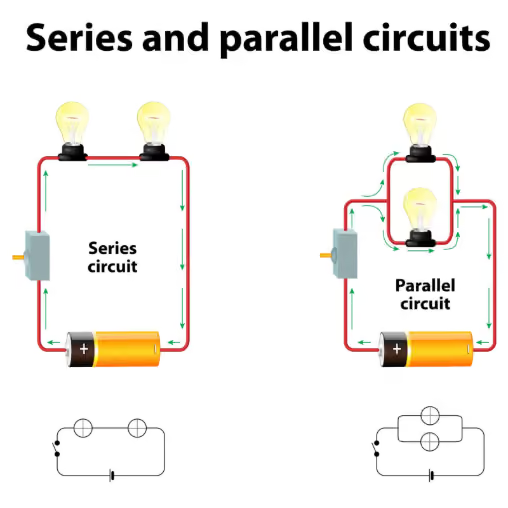
Conexión en serie
- Ventajas: La resistencia total es la suma de las resistencias individuales, lo que mantiene la corriente en un nivel seguro para el FACP. La fórmula para la resistencia total en un circuito en serie es:
Req =R1 +R2 +...+Rn
- Ejemplo: Los mismos 10 generadores conectados en serie tendrían una resistencia equivalente de 8 Ω (Req =10×0.8Ω). Esto limita la corriente a unos seguros 3 Amperios (I=24V/8Ω).
- Desventajas: Este método es vulnerable a un punto único de fallo. Si la resistencia de un generador se rompe, el circuito se interrumpe y todos los generadores subsiguientes no se activarán. Esto podría provocar un fallo crítico en una situación de extinción de incendios.
Conexión en paralelo
- Ventajas: Este método de conexión ofrece redundancia. Si un generador falla, los demás seguirán recibiendo corriente y se activarán.
- Desventajas: La resistencia equivalente (Req ) del circuito disminuye a medida que se añaden más generadores. La fórmula para la resistencia total en un circuito en paralelo es:
1/Req =1/R1 +1/R2 +...+1/Rn
Esta baja resistencia genera un problema importante. Según la Ley de Ohm (I=V/R), una resistencia baja provoca una corriente elevada. Esto puede dañar fácilmente la FACP, ya que la mayoría de los paneles no están diseñados para soportar las altas demandas de corriente de múltiples generadores en paralelo.
- Ejemplo: Una FACP de 24V conectada a 10 generadores (cada uno con una resistencia de 0.8 Ω) en paralelo tendría una resistencia equivalente de solo 0.08 Ω. Esto requeriría una corriente de 300 Amperios (I=24V/0.08Ω), superando con creces el límite típico de 3 amperios de la mayoría de las salidas de las FACP.
Cómo la interfaz SCR garantiza una activación fiable de múltiples generadores
Para superar el problema del punto único de fallo en un circuito en serie, cada generador necesita un diodo que mantenga el flujo de corriente incluso si una resistencia se rompe. Sin embargo, la instalación manual de diodos individuales es compleja e ineficiente (ver el esquema de cableado adjunto).
De hecho, cada diodo provoca una caída de tensión (aproximadamente 1-1.5V), lo que limita el número de generadores a unos 10 antes de que la tensión sea demasiado baja para una activación fiable.
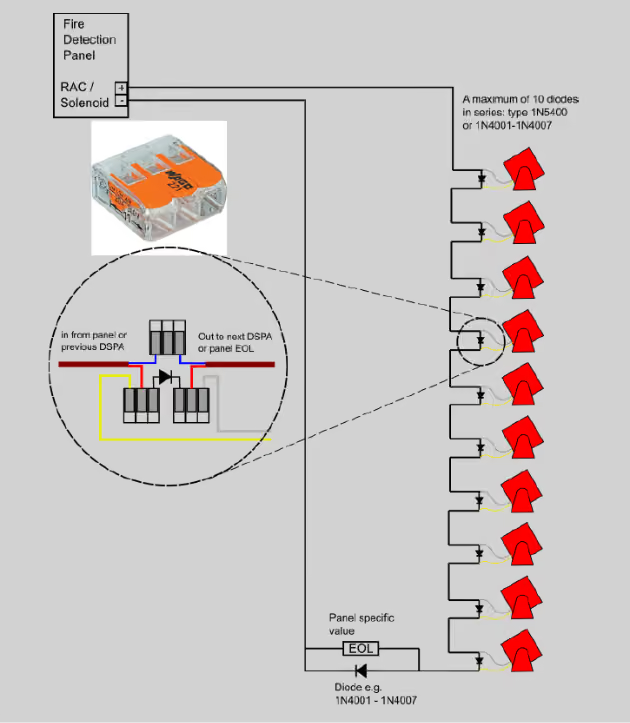
La interfaz SCR es la solución definitiva a estos desafíos. Utiliza un único controlador SCR para regular la corriente en todo el circuito, mientras que los reenvíos SCR independientes —uno para cada generador— gestionan la distribución desde cada generador individual.
- Instalación simplificada: Sustituye la necesidad de instalaciones manuales y complejas de diodos por un único dispositivo eficiente.
- Mayor capacidad: La interfaz SCR maximiza la corriente, permitiéndole activar hasta 15 generadores DSPA desde un único FACP*.
- Seguridad mejorada: Los reenvíos SCR, que incluyen cajas de conexiones, cuentan con terminales etiquetados para realizar conexiones fáciles y seguras, incluidas las de los diodos y la resistencia de fin de línea.
La interfaz SCR ofrece una solución robusta, sencilla y escalable que garantiza que su sistema de extinción de incendios DSPA sea técnicamente sólido y altamente fiable.
*Nota: El FACP debe tener una salida mínima de 500 mA y 20,5 Vcc.
¿Listo para ver cómo la interfaz SCR puede encajar en su próximo proyecto?
📩 Contacte con DSPA para obtener las especificaciones técnicas completas y orientación sobre la integración.